Updated October 13, 2026
If you have a gun collection to sell, one question matters more than most: at what point does selling guns turn a private owner into a “dealer” who needs a federal license? In 2026, a federal court threw out the ATF rule that tried to answer that question, and the ATF has proposed a narrower replacement. Here is what changed, what did not, and what it means if you are selling a collection in Florida.
The short version
- The 2024 ATF “engaged in the business” rule has been vacated by a federal court in Texas.
- The federal law underneath it did not change. Selling all or part of a personal collection is still excluded from the definition of a dealer.
- The ATF has proposed a new, slimmer rule. As of this writing it is a proposal, not a final rule.
- Every rule about who you can sell to still applies: no sales to prohibited persons, buyers under 21 cannot purchase in Florida, and interstate sales must go through a licensed dealer (FFL).
What the 2024 rule did
In 2022, Congress changed the federal definition of a firearms dealer in the Bipartisan Safer Communities Act. A dealer became someone who buys and resells guns as a regular course of business “to predominantly earn a profit,” replacing the older “livelihood and profit” test.
In April 2024, the Bureau of Alcohol, Tobacco, Firearms and Explosives (ATF) issued a rule to put that change into practice. It added a list of situations where a seller would be presumed to be a dealer, such as reselling a gun shortly after buying it, or offering guns while able to take more orders. Collectors and gun-rights groups argued the presumptions shifted the burden onto ordinary sellers to prove they were not running a business.
What the court decided
Texas, Louisiana, Mississippi, and Utah, joined by several gun-rights groups, challenged the rule in the U.S. District Court for the Northern District of Texas. A preliminary injunction in June 2024 blocked enforcement against the plaintiffs. On June 12, 2026, Judge Matthew Kacsmaryk entered final judgment vacating the rule (Guns.com, June 14, 2026).
The government asked the court to keep parts of the rule in place. On August 13, 2026, the court refused and left the rule vacated in its entirety (NRA-ILA, Aug. 31, 2026). A federal court in Alabama reached a similar result in a separate case in September 2025, according to the ATF’s own summary of the litigation.
Source note: Guns.com and NRA-ILA are pro-gun outlets. The dates and outcome above match the ATF’s description of the case history in its May 2026 proposal.
What the ATF has proposed instead
On May 6, 2026, the ATF published a proposed rule to revise the 2024 regulations (Federal Register, 91 FR 24424). The comment period closed August 4, 2026. The proposal would:
- Remove the list of presumptions that a seller is a dealer.
- Define “engaged in the business” by tracking the wording of the statute itself.
- Keep a revised definition of “predominantly earn a profit.”
- Remove the separate regulatory definition of “personal collection” for non-licensees.
- Keep the exception for auctioneers who provide estate-type auction services on commission.
The ATF said the 2024 rule did not increase licensing and that its presumptions had not been cited in any court case. When ruling in August, the Texas court took a dimmer view, saying the proposal repeats much of the old rule’s substance. Until a final rule is published, the statute is the standard that applies.
What the law still says
Under 18 U.S.C. § 921(a)(21)(C), a dealer is someone who regularly and repeatedly buys and resells firearms as a business, mainly to make money. The same section excludes a person who makes occasional sales to enhance a personal collection or for a hobby, or who sells all or part of a personal collection. Section 921(a)(22) explains that “predominantly earn a profit” means the main motive is financial gain, as opposed to goals such as improving or liquidating a personal collection.
In plain terms: selling Grandpa’s collection, thinning out your safe, or liquidating an estate is generally not “dealing.” Buying guns specifically to flip them for profit, over and over, can be.
What this means if you are selling in Florida
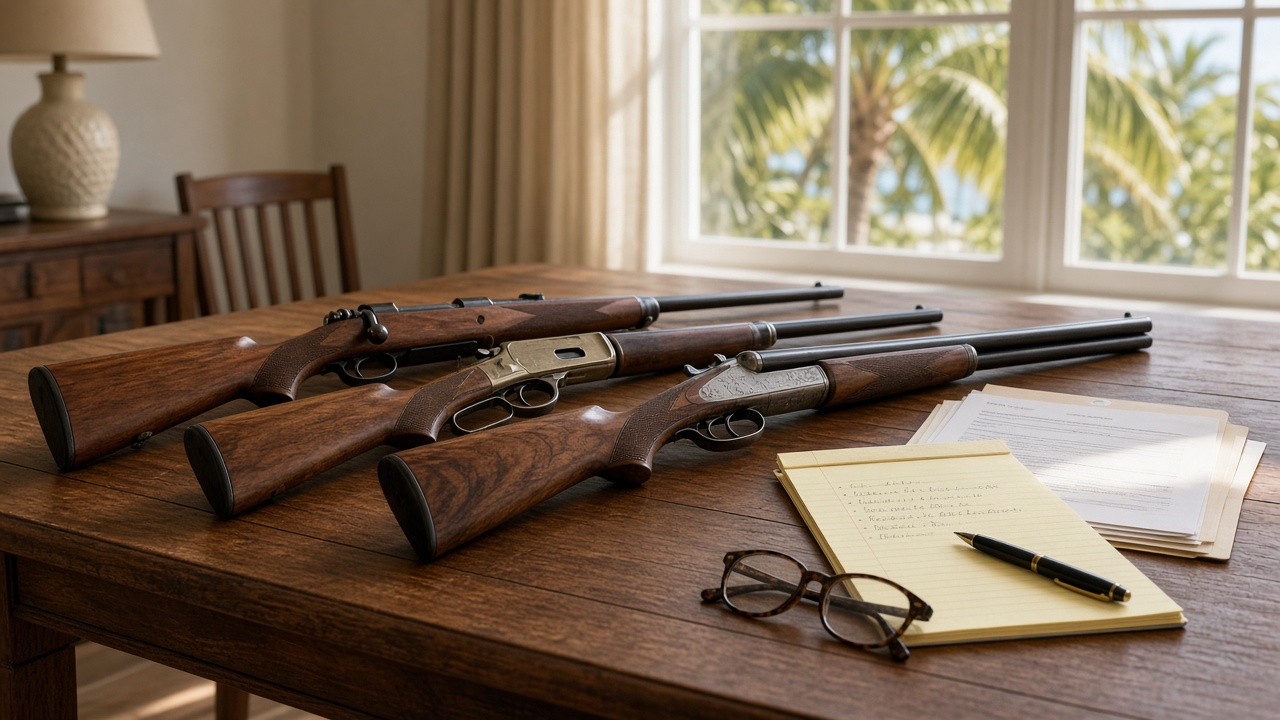
Selling a collection or an estate
The vacated rule removes a layer of uncertainty for collectors and families settling an estate. The core test is the statute, and liquidating a personal collection sits on the excluded side of that line.
Selling privately
Florida allows private sales between Florida residents, but the seller carries the responsibility. You may not sell to someone you know or have reason to believe is prohibited. Under Florida law, a person younger than 21 may not purchase a firearm, with limited exceptions (Fla. Stat. § 790.065(13)). Some counties also require a background check and a 3 to 5 day wait for sales at gun shows and other public venues.
Selling through a licensed auction
When you consign through a federally licensed auction house, the licensed side of the transaction is handled for you. Every buyer completes a transfer through an FFL, including the background check and paperwork. You do not have to vet strangers, and out-of-state bidders can buy because the guns ship FFL to FFL. Competitive bidding from a wide pool of buyers can also bring higher prices than a single fixed offer.
Frequently asked questions
Do I need an FFL to sell my gun collection?
Generally no. Federal law excludes people who sell all or part of a personal collection from the definition of a dealer. The facts of each situation matter, so talk to an attorney if you buy and resell regularly.
Is the 2024 “engaged in the business” rule still in effect?
No. A federal court in Texas vacated it in June 2026 and declined to revive any part of it in August 2026. The ATF has proposed a replacement that is not yet final.
Does this change background check rules?
No. Licensed dealers still run background checks on every sale, and the federal ban on selling to prohibited persons applies to everyone.
Thinking about selling?
Accurate Gun Auctions is a Florida-based, FFL-licensed firearm auction house. We catalog, photograph, and market your guns to a broad pool of qualified bidders and handle every transfer through licensed channels. Request a free consignment estimate or call 844-486-3325.
This article is for general information only and is not legal advice. Laws change; consult a qualified attorney or the relevant agency (FDLE, ATF, or FDACS) before buying, selling, or transferring a firearm.