The Ultimate Guide to Understanding Firearm Buy Back Programs
What a Gun Buyback Program Actually Is (And Why It Matters)
A what is a buy back program for guns question gets asked more often than you might think — and the short answer is this:
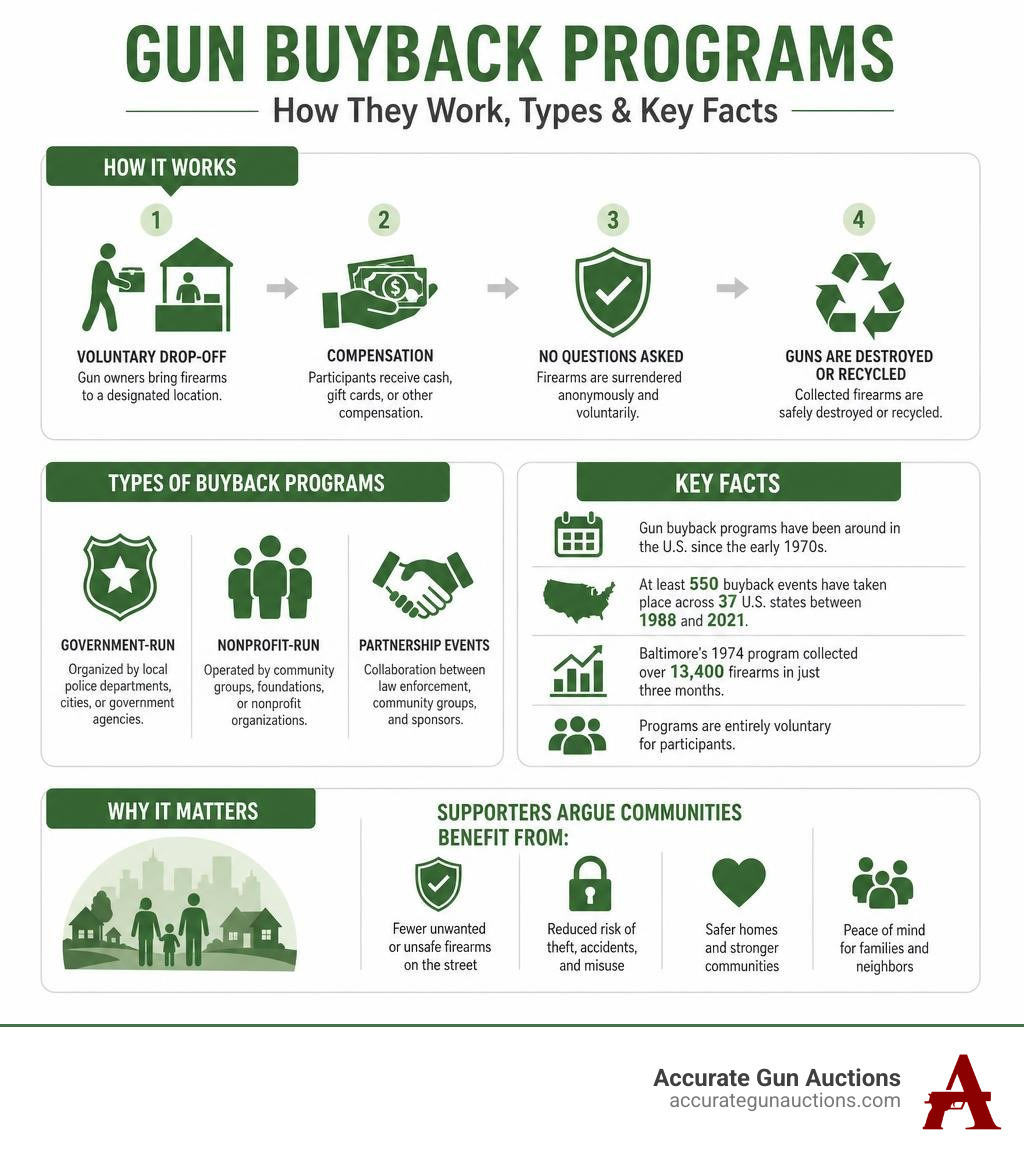
A gun buyback program is a government or privately run initiative that purchases privately owned firearms from the public, with the goal of reducing the number of guns in circulation.
Here’s a quick breakdown:
- Who runs them: Usually local police departments, though private organizations and government agencies also operate them
- How they work: Gun owners voluntarily bring in firearms and receive cash, gift cards, or other compensation — no questions asked
- What happens to the guns: Collected firearms are typically destroyed or recycled
- Is it mandatory? In the U.S., almost all buyback programs are entirely voluntary
- Who benefits? Supporters argue communities benefit from fewer unwanted or unsafe firearms on the street
Gun buyback programs have been around in the U.S. since the early 1970s. Philadelphia ran some of the first known events, and Baltimore’s 1974 program collected over 13,400 firearms in just three months. Since then, at least 550 buyback events have taken place across 37 U.S. states between 1988 and 2021.
They sound simple. But the reality — how they’re funded, who actually shows up, and whether they reduce violence — is far more complicated.
This guide breaks it all down clearly, so you can understand exactly what these programs are, how they differ around the world, and what your options really are if you’re looking to part with a firearm.
What is a Buy Back Program for Guns?
To truly understand what is a buy back program for guns, we must look beyond the simple exchange of weapons for cash. At its core, a gun buyback is a public safety campaign designed to lower the volume of civilian-held firearms. The underlying logic is straightforward: fewer guns in a community mean fewer opportunities for accidental discharges, domestic violence escalations, suicides, and gun thefts.
According to the Wikipedia Gun Buyback Overview, these programs are designed to purchase privately owned firearms to reduce both legally and illegally owned weapons.
In the United States, these initiatives are almost always voluntary. A local entity—frequently a municipal government or a police department—announces a date, time, and location where citizens can surrender their firearms. In exchange, the participants receive compensation.
However, calling this a “buyback” is technically a bit of a misnomer. The government or local police department didn’t sell you the firearm in the first place, so they aren’t buying it “back.” Instead, they are acting as a purchasing agent of last resort, offering a financial incentive to encourage people to part with weapons they no longer want or need.
The incentives themselves vary widely. Rather than raw cash, most modern U.S. programs hand out prepaid gift cards to local grocery stores, gas stations, or major retailers like Target. These gift cards typically range in value from $50 for inoperable weapons or non-firing replicas, up to $100 or $200 for working handguns, rifles, and shotguns. In some specialized events, higher amounts—sometimes up to $500—are offered for semi-automatic “assault weapons.”
The Mechanics of How a Buy Back Program for Guns Works
The operational success of a local buyback event hinges on a single, crucial policy: no questions asked.
When a participant drives up to a designated drop-off location—which is often a neutral community space like a church parking lot, a school, or a public park rather than a police station—they are met by law enforcement officers or volunteer staff. The participant is not required to show identification, explain how they obtained the firearm, or register their personal information. This strict anonymity is designed to encourage individuals who might possess illegal, unregistered, or inherited firearms to surrender them without fear of prosecution for unlawful possession.
Once the firearm is handed over, the process moves quickly:
- Safety Inspection: Officers immediately inspect the firearm to ensure it is unloaded and safe to handle.
- Compensation: The participant is handed their gift card or voucher and sent on their way.
- Database Check: Although the program is anonymous for the person surrendering the weapon, the firearms themselves are run through national databases to determine if they have been reported stolen. If a gun is flagged as stolen, law enforcement will make an effort to return it to its rightful owner.
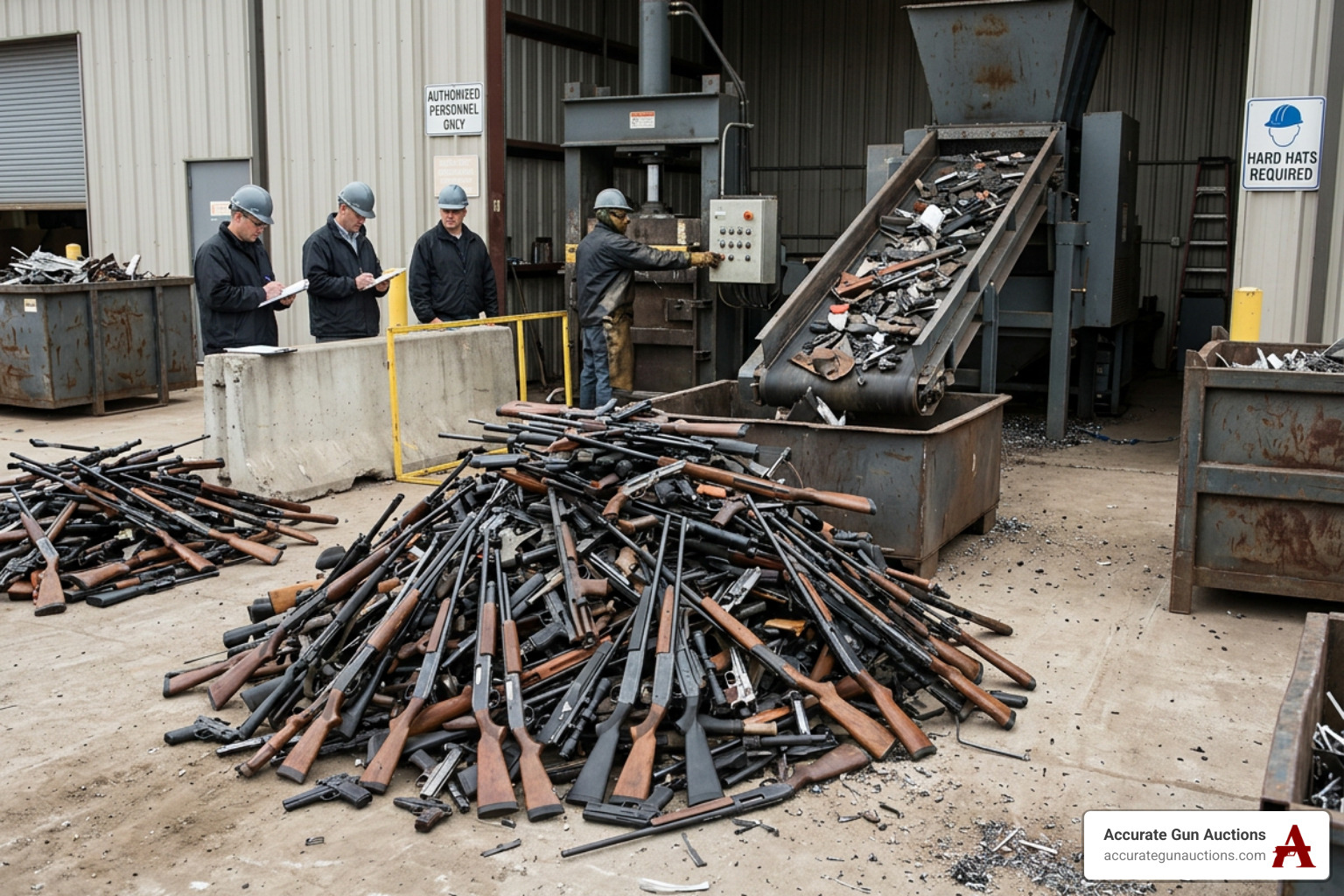
- Destruction: If the firearm is not stolen or tied to an active criminal investigation, it is slated for permanent destruction. The weapons are typically melted down, shredded, or cut into pieces using industrial saws, rendering them permanently inoperable.
For those living in the Sunshine State, tracking these events can be highly localized. You can learn more about how these events are managed regionally by reading our guide on Florida Gun Buyback Programs.
Legislation-Led vs. Voluntary Amnesty Schemes
While almost all programs in the U.S. are voluntary, localized initiatives, gun buybacks globally fall into three distinct categories:
- Legislation-Led Compensation Schemes: These are mandatory programs enacted by federal or national governments. When a country passes laws banning specific classes of firearms, they must provide a mechanism for citizens to surrender those newly prohibited items in exchange for fair financial compensation. This is a legal requirement in many democratic countries to avoid “uncompensated takings” of private property.
- Incentivised Amnesty Schemes: These are voluntary, temporary windows where citizens can surrender illegal or unregistered firearms without facing criminal charges for possession, often accompanied by a small financial incentive.
- Private Buybacks: These are organized and funded entirely by private citizens, non-profits, or community groups. For example, following major national tragedies, private donors or community organizations have stepped up to fund local buybacks, sometimes partnering with local police to handle the physical weapons safely.
To encourage participation without spending direct taxpayer cash, some U.S. states have attempted to use creative legislative tools. For instance, California introduced bills like the California AB-232 Bill Text, which aimed to establish state-supported voluntary buyback programs that offered state income tax credits to individuals surrendering their firearms ($250 for standard handguns or rifles, and up to $500 for semi-automatic firearms). Though these tax-incentive models face high legislative hurdles, they show how policymakers constantly try to reinvent the buyback concept.
Global Examples of Gun Buyback Initiatives
To understand the full scope of what these programs can achieve, we have to look at how they are deployed internationally. On the global stage, gun buybacks have occasionally been massive, country-altering events.
- Australia (1996–1997): Perhaps the most famous mandatory buyback in history occurred after the tragic Port Arthur massacre. The Australian government banned rapid-fire long guns and launched the National Firearms Buyback Program. Over 12 months, the government retrieved and destroyed approximately 650,000 firearms—representing roughly 20% of all privately held guns in the country. The program cost $304 million in compensation and $63 million in administration, funded by a temporary tax levy.
- Brazil (2003–2009): Brazil implemented two massive national gun buyback programs as part of its Disarmament Statute. Across these initiatives, the Brazilian government collected and destroyed over 1.1 million firearms, using widespread public awareness campaigns to drive participation.
- Argentina (2007–2008): Argentina’s national program was highly successful relative to the size of its population. The government collected 104,782 firearms (about 7% of the country’s estimated total civilian inventory) along with 747,000 units of ammunition, offering financial incentives for every item surrendered.
- United Kingdom: In the UK, police forces regularly hold weapon and knife amnesties. However, unlike the U.S., these are typically uncompensated amnesties—meaning citizens turn in legally or illegally held weapons for safe destruction at any time without receiving any money or gift cards.
The 2026 Canadian Assault-Style Firearms Compensation Program
A major real-time example of a legislation-led buyback is unfolding right now in Canada. Following a federal ban on more than 2,500 makes and models of “assault-style” firearms, the Canadian government launched its national compensation program.
According to the CBC News Canada Gun Buyback Report, the federal government allocated a massive funding pool of $248.6 million to compensate owners for an estimated 136,000 outlawed firearms.
Because the program is mandatory for compliance, the government established an amnesty period to protect licensed owners from criminal liability while the logistics were ironed out. This amnesty period is scheduled to officially expire on October 30, 2026. Canadian firearm owners have had to navigate a complex declaration portal, with compensation payments processed within 45 business days of validation. The program has faced heavy resistance from several provincial governments, including Alberta and Saskatchewan, illustrating the deep political divisions that mandatory buybacks can spark.
United States Local and Federal Initiatives
Unlike Canada or Australia, the United States has never implemented a mandatory national gun buyback. Because of the Second Amendment and deeply rooted cultural views on gun ownership, U.S. efforts remain strictly voluntary and local.
At the federal level, lawmakers have repeatedly tried to provide funding for these local efforts. A prime example is the Safer Neighborhoods Gun Buyback Act of 2025 (H.R. 2948). As detailed in the H.R. 2948 Legislative Text, this bill proposed authorizing $360 million annually for fiscal years 2025 through 2027 to provide federal grants to states, local governments, tribal governments, and even licensed gun dealers.
Under this proposed framework, buybacks would utilize specialized “smart prepaid cards” loaded with 125% of the market value of the surrendered firearm. To prevent these events from simply fueling more gun sales, the cards would be programmed to block transactions at gun shops or any merchant category codes associated with firearms and ammunition.
Analyzing the Effectiveness and Criticisms of Buybacks
Are gun buybacks actually effective at stopping crime? It is a question that researchers, politicians, and gun owners have debated for decades.
When we look at the hard data, the consensus among criminologists is surprisingly consistent. According to a comprehensive RAND Corporation Gun Buyback Analysis, there is almost no empirical evidence showing that voluntary gun buyback programs lead to a measurable reduction in violent crime, homicides, or gun-related injuries in the United States.
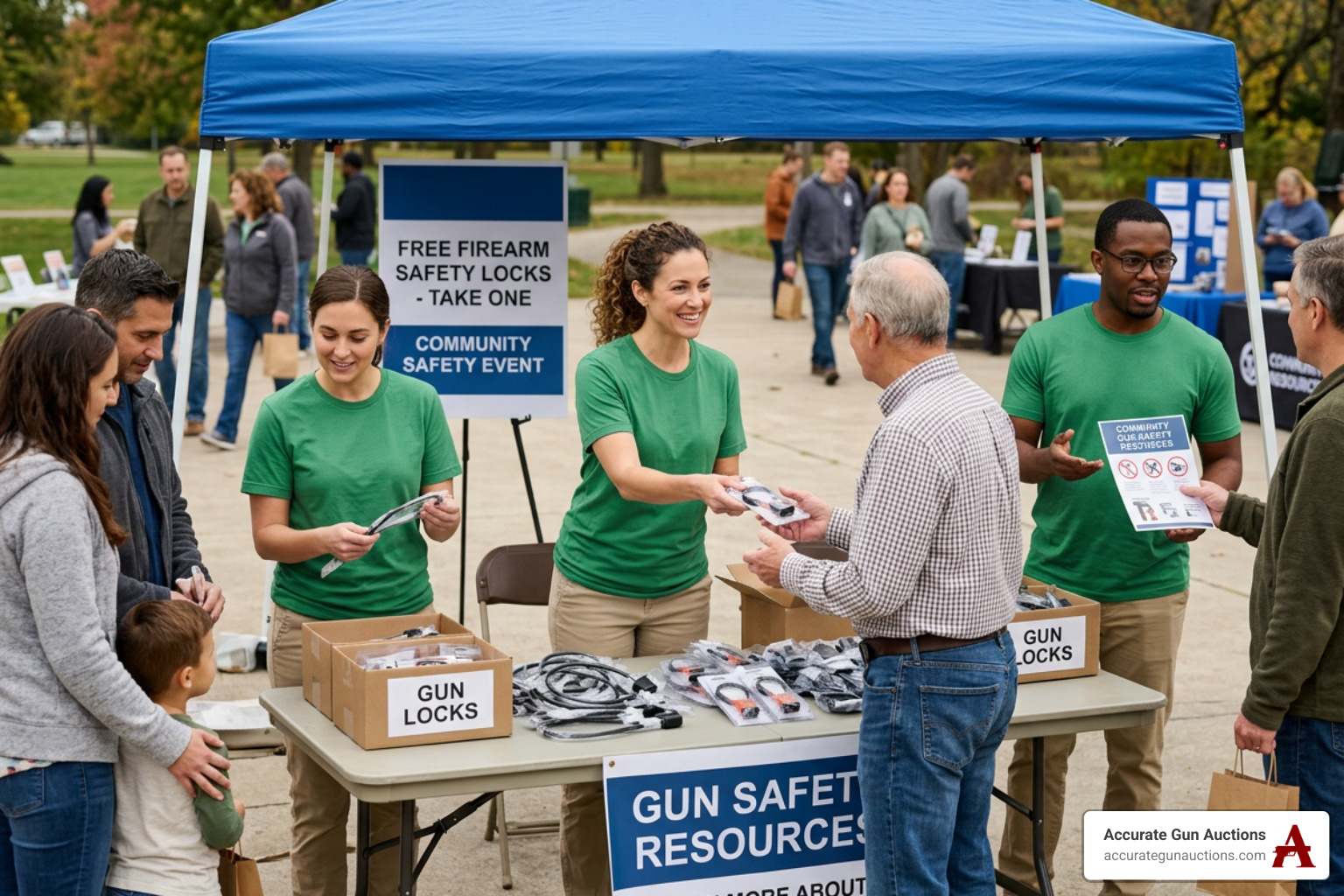
While that sounds disappointing, it does not mean buybacks are completely useless. Researchers suggest that while buybacks do not stop street crime, they can have a modest, positive impact on reducing suicides and accidental shootings—particularly among older demographics—by removing unwanted, unsecured firearms from households. They also serve as highly visible community events that raise awareness about gun safety and provide opportunities to distribute free gun locks.
Why Critics Question What is a Buy Back Program for Guns
So, why is the evidence for their effectiveness so thin? Criminologists point to several structural flaws inherent to voluntary buybacks:
- The Demographic Mismatch: The people who participate in buybacks are rarely the people committing gun violence. Studies show that a majority of buyback participants are older, White, suburban residents or widows who have inherited unwanted firearms. Conversely, the demographic most at risk for interpersonal gun violence consists of young men in urban areas.
- The Firearm Mismatch: The weapons turned in at buybacks are rarely the types of weapons used in violent crimes. Buybacks are flooded with old, rusted hunting rifles, single-shot shotguns, inoperable revolvers, and military surplus bolt-action rifles. Street crimes are overwhelmingly committed with modern, semi-automatic handguns.
- The “Other Guns at Home” Factor: Surveys of buyback participants show that between 51% and 60% of them still have at least one other firearm remaining in their household after turning one in.
- Financial Gaming: Because buybacks operate on a “no questions asked” basis, they are ripe for exploitation. In a detailed report by The Trace Gun Buyback Study, researchers highlighted instances of participants “gaming” the system. People have been known to buy cheap, broken firearms online for $20 and turn them in for a $100 gift card. More recently, individuals have used 3D printers to manufacture cheap plastic receivers (ghost guns) solely to exchange them for high-value gift cards at municipal events.
- The “Open-Air Gun Bazaar” Phenomenon: During a famous 2013 buyback in Seattle, private collectors and licensed dealers stood on the sidewalks outside the police drop-off zone. They approached people in line, offered them real cash for their highly valuable, collectible firearms, and bought them right there on the street. The police ended up with the low-value junk, while the high-functioning, valuable firearms went right back into private hands.
Policy Recommendations for Improving Program Outcomes
To address these limitations, policy experts have proposed several design changes to make buybacks more impactful:
- Incentivize the Right Guns: Offer significantly higher payouts for operational semi-automatic handguns and modern semi-automatic rifles, while offering little to nothing for rusted, broken, or inoperable long guns.
- Move Away from Police Stations: Hold events at trusted community venues like churches, health clinics, or community centers to encourage participation from high-risk individuals who may be distrustful of law enforcement.
- Add Strict Rules for 3D-Printed Guns: Require that any surrendered privately manufactured firearm (PMF) be fully functional and capable of firing multiple rounds to qualify for compensation.
- Mandate Safe-Storage Partnerships: Every buyback event should double as a safety drive, handing out free cable locks, trigger locks, and educational materials on safe storage.
Alternatives for Gun Owners: Selling vs. Surrendering
If you live in Florida—whether you are in Clearwater, Tampa, Orlando, Miami, Jacksonville, St. Petersburg, Tallahassee, Fort Lauderdale, The Villages, or Naples—and you have a firearm you no longer want, participating in a police buyback is rarely your best option.
Why? Because you are leaving a massive amount of money on the table.
When you hand a gun over to a buyback, you are surrendering an asset. Many older, inherited, or collectible firearms are worth hundreds—or even thousands—of dollars. Accepting a $100 grocery gift card for a high-quality firearm is a major financial loss.
Fortunately, you have much better legal options. You can sell your firearm safely, legally, and for its true market value. If you want to know how the legalities work in our state, check out our comprehensive guide on How to Sell Guns in Florida.
For those looking for the absolute best return on their investment, finding a reputable, licensed platform is key. You can read about your options in our detailed breakdown of the Best Place to Sell Gun Florida.
Here is a direct comparison of how a government-run buyback stacks up against selling your firearm through a professional online auction platform like Accurate Gun Auctions:
| Feature | Government Gun Buyback | Accurate Gun Auctions |
|---|---|---|
| Compensation Type | Low-value retail gift cards ($50 – $200) | Cold, hard cash (Direct deposit or check) |
| Payout Amount | Flat rate, usually a fraction of the gun’s real value | Fair market value determined by nationwide bidding |
| Legal Compliance | Anonymous, but no formal FFL transfer paperwork | 100% compliant; we handle all ATF paperwork & background checks |
| Gun’s Destination | Destined for the melting pot or industrial shredder | Transferred to a licensed buyer who appreciates the firearm |
| Target Audience | People wanting fast, anonymous disposal of low-value items | Gun owners wanting maximum financial return safely |
| Effort Required | Waiting in long car lines at a designated local event | We handle all the marketing, cataloging, shipping, and compliance |
At Accurate Gun Auctions, we serve gun owners across Florida and the entire United States. Our online platform connects your firearms with a nationwide network of qualified buyers, ensuring you get the absolute maximum value for your property while we handle every ounce of the legal paperwork, shipping, and compliance.
Frequently Asked Questions about Gun Buybacks
Are gun buyback programs anonymous?
Yes, almost all local voluntary buybacks in the United States operate under a strict “no questions asked” policy. You do not have to show ID or give your name. However, police will check the serial numbers of the collected firearms against national databases to see if they have been reported stolen. If a gun is stolen, they will attempt to return it to the rightful owner; if it is clean, it is marked for destruction.
What happens to the weapons collected during a buyback?
With very few exceptions, the weapons are permanently destroyed. They are typically cut into pieces with band saws, crushed, or sent to a steel foundry to be melted down. Some jurisdictions recycle the metal into rebar, park benches, or even community art installations.
Can I get fair market value for my firearm at a buyback?
Absolutely not. Buyback programs offer flat-rate compensation (usually $50 to $200 in gift cards) regardless of the manufacturer, rarity, or condition of the firearm. A rare, vintage Colt revolver worth $1,200 will receive the exact same $100 gift card as a rusted, broken Saturday Night Special.
If you want to get real cash for your valuable firearms, you should avoid buybacks entirely. Instead, explore our specialized services like Cash for Guns Florida or learn how to safely list your items on our platform at Sell My Guns Florida.
Conclusion
Understanding what is a buy back program for guns helps us see these initiatives for what they truly are: community-focused safety events designed to remove unwanted, low-value firearms from households. While they are great at distributing free gun locks and raising awareness, they are statistically ineffective at stopping street crime—and they are a terrible financial deal for anyone holding a valuable, functional firearm.
If you have inherited a collection, are downsizing, or simply have firearms you no longer use, do not hand them over to a police buyback for a cheap gift card.
Let us help you sell them safely, legally, and for their true market value. At Accurate Gun Auctions, we take care of all the compliance, marketing, and shipping, getting your firearms in front of a nationwide audience of eager buyers.
Ready to see what your firearms are actually worth? Get top value for your firearms through our hassle-free online auction platform today!