
How to Legally Transfer a Gun in Georgia with a Bill of Sale
What Every Georgia Gun Seller Needs to Know Before a Private Transfer
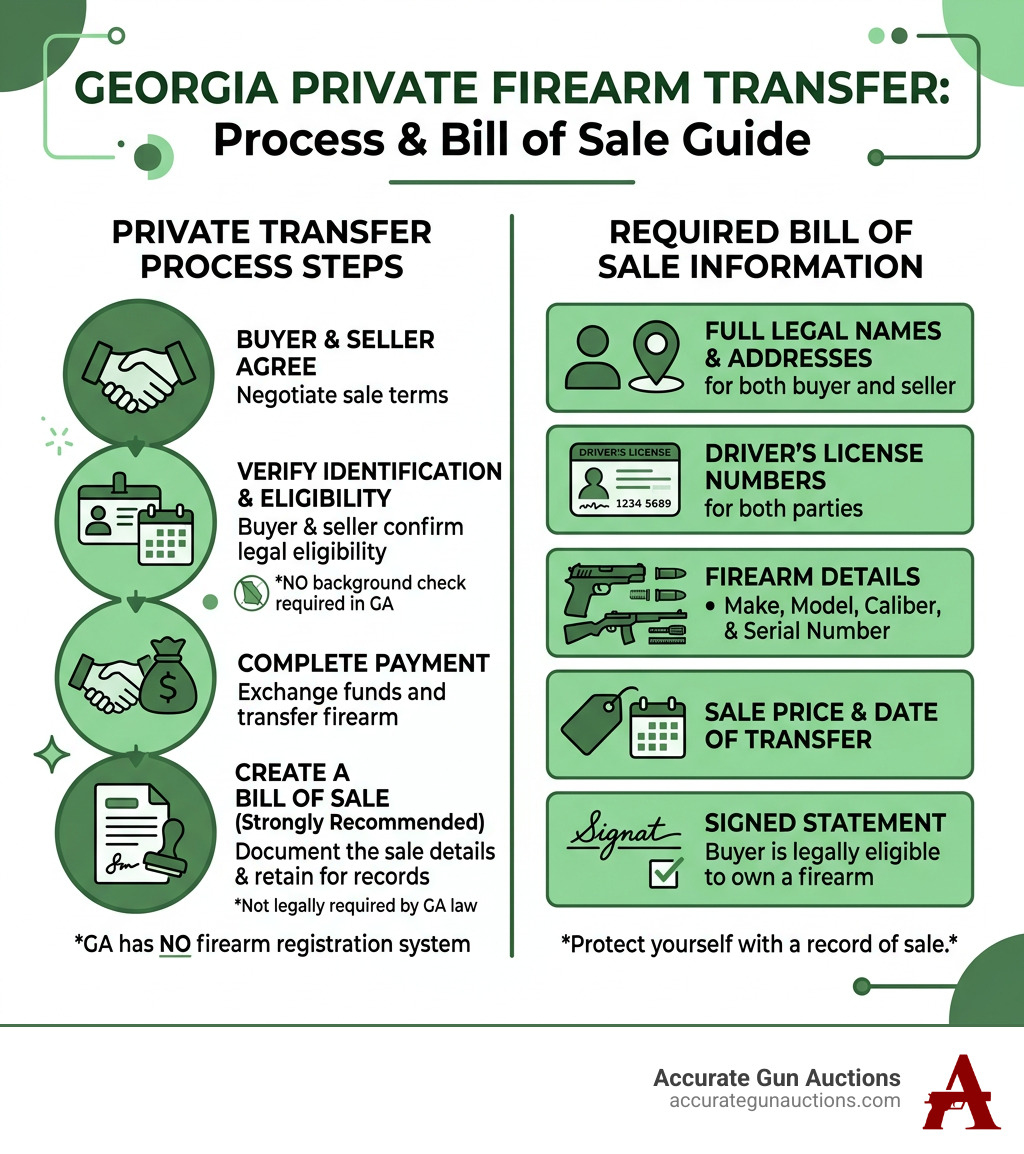
A Georgia firearm bill of sale is one of the smartest documents you can use when selling a gun privately — even though Georgia law doesn’t require it.
Here’s what you need to know right away:
- Georgia does not require a background check for private firearm sales between unlicensed individuals
- Georgia has no firearm registration system
- A bill of sale is not legally required in Georgia, but it is strongly recommended
- Without one, you have no written proof that you transferred ownership — which can become a serious problem if that gun is later linked to a crime
What a Georgia Firearm Bill of Sale should include:
- Full legal names and addresses of both buyer and seller
- Driver’s license numbers for both parties
- Firearm make, model, caliber, and serial number
- Sale price and date of transfer
- A signed statement that the buyer is legally eligible to own a firearm
Georgia’s strong gun-ownership culture and constitutional carry laws make private sales common and straightforward. But “easy” doesn’t mean “risk-free.” One Georgia attorney described a client who sold a revolver to a coworker with no paperwork — and spent weeks under investigation after that gun turned up at a crime scene. A simple bill of sale could have cleared him immediately.
The bottom line: a bill of sale doesn’t register your gun with anyone. It just proves you no longer own it.
Why You Need a Georgia Firearm Bill of Sale for Private Transfers
As we head through June 2026, gun ownership rules continue to be a major topic of discussion across the Southeast. For those of us operating in Florida—with our main offices in Clearwater, Tampa, Orlando, Miami, Jacksonville, St. Petersburg, Tallahassee, The Villages, Naples, and Fort Lauderdale—we frequently assist folks who navigate the subtle differences between Florida and Georgia gun laws. If you are curious about how things work just south of the border, you can check out our guide on Florida Gun Laws 2026 to see how the Sunshine State compares.
In Georgia, the law is incredibly permissive when it comes to private sales. Unlicensed individuals can buy and sell firearms without going through a licensed dealer, meaning there is no state-mandated background check, no waiting period, and absolutely no state-run registry.
While this freedom is highly valued by local gun owners, it places a heavy burden of responsibility on the seller. Under federal law, it is a felony punishable by up to 10 years in prison and a $250,000 fine to knowingly sell or transfer a firearm to a prohibited person.
Without a paper trail, how do you prove that you did your due diligence? That is where a Free Georgia Firearm Bill of Sale Form comes in. This document acts as your legal shield. It proves the exact date and time the firearm left your possession, identifies who took ownership of it, and records the buyer’s formal declaration that they are legally permitted to own firearms.
Should law enforcement ever knock on your door because a firearm you once owned was recovered at a crime scene, handing them a completed bill of sale immediately shifts the focus of the investigation away from you.
Key Elements of a Valid Georgia Firearm Bill of Sale
To ensure your document holds up under legal scrutiny, it cannot simply be a scribble on a napkin. It needs to be a structured, comprehensive record of the transaction.
Essential Information for Your Georgia Firearm Bill of Sale
When drafting or filling out your Georgia Firearm Bill of Sale Template, make sure you record every detail with absolute precision. Any typo in a serial number or a misspelled name can weaken the document’s protective value.
Your bill of sale must include:
- The Parties’ Information: Full legal names, physical residential addresses (no P.O. Boxes), and contact phone numbers for both the buyer and the seller.
- Government Identification: Record the driver’s license numbers or state ID numbers of both individuals. This acts as physical proof that you verified who you were dealing with.
- Exact Firearm Specifications:
- Make: (e.g., Glock, Smith & Wesson)
- Model: (e.g., 19 Gen 5, Shield)
- Caliber/Gauge: (e.g., 9mm, .12 gauge)
- Serial Number: Double-check this directly on the frame of the gun. Do not rely solely on your memory or old boxes.
- Type: (e.g., Pistol, Rifle, Shotgun)
- Financial Terms: The exact purchase price agreed upon, or a clear indication if the transfer is a gift or a trade.
- The Date and Signatures: The precise calendar date the physical transfer occurred, accompanied by the signatures of both parties.
Buyer Eligibility and Seller Disclosures
The heart of the legal protection lies in the disclosures and eligibility statements. A robust bill of sale must include a section where the buyer explicitly signs off on their legal status.
This section should require the buyer to declare, under penalty of perjury, that they:
- Are of legal age to purchase the firearm (at least 18 for private transfers under federal law).
- Are a legal resident of the state of Georgia (interstate private sales are illegal without an FFL).
- Are not a prohibited person under federal or state law (e.g., no felony convictions, active domestic violence restraining orders, or drug dependency).
Additionally, the seller should include a disclosure stating that the firearm is being sold in “as-is” condition, with no written or implied warranties. This protects you if the buyer takes the firearm to a range and experiences a mechanical malfunction, preventing them from claiming you knowingly sold them a defective or dangerous item.
Georgia Firearm Bill of Sale vs. T-7 Vehicle Bill of Sale
A common point of confusion for Georgia residents is the difference between a standard personal property bill of sale and the official forms provided by the state.
If you have ever sold a car, truck, or trailer in Georgia, you are likely familiar with the Official Georgia T-7 Bill of Sale issued by the Department of Revenue. The T-7 form is a rigid, legally mandated document required to transfer vehicle titles and register a motor vehicle at the county tag office.
Firearms, however, do not have a state-run registry. The state government does not want, nor do they accept, copies of your firearm bills of sale. This document is strictly for your personal records.
| Feature | Georgia Firearm Bill of Sale | Official Georgia T-7 Bill of Sale |
|---|---|---|
| Governing Agency | None (Private record) | Georgia Department of Revenue |
| Legally Required? | No, but highly recommended | Yes, for non-titled vehicle transfers |
| Must Be Filed with State? | No, keep in your personal files | Yes, submitted to County Tag Office |
| Primary Purpose | Liability protection & proof of transfer | Title transfer & tax assessment |
| Key Information | Serial number, caliber, buyer eligibility | VIN, odometer reading, plate number |
Best Practices for Private Gun Sales in Georgia
Private sales can be incredibly smooth if you follow a disciplined set of personal safety and legal guidelines.
Verifying Identity and Age for a Georgia Firearm Bill of Sale
Even though Georgia adopted constitutional carry, allowing eligible citizens to carry concealed weapons without a permit, you as a seller must still perform basic due diligence.
First, always demand to see a valid, government-issued photo ID. If you are in Florida or dealing with regional transfers, you can read about how we handle this in our neighboring state via the guide on how to Legally Sell a Firearm in Florida Private Sale Rules 2026.
In Georgia:
- Verify Residency: Ensure the buyer’s driver’s license is a Georgia-issued ID. Private sales across state lines are a federal crime. If the buyer is from out of state, the transaction must go through a licensed Federal Firearms License (FFL) dealer.
- Verify Age: Under federal law, the minimum age to receive any firearm in a private transfer is 18.
- Check for a Carry Permit: While no longer required to carry, a Georgia Weapons Carry License (WCL) is a seller’s best friend. It proves the buyer has passed a recent background check. If they have a valid WCL, you can feel highly confident they are not a prohibited person.
- The “Walk Away” Rule: If a buyer refuses to show their ID, objects to signing a bill of sale, or acts suspiciously, cancel the sale immediately. No amount of cash is worth a felony charge or a lifetime of legal regret.
Safe Meeting Locations and Record Retention

Never agree to meet a stranger in a dark alley, an abandoned parking lot, or at your private home.
The gold standard for private firearm transactions is the parking lot of a local police department or sheriff’s office. Many law enforcement agencies across Georgia and Florida designate specific, camera-monitored parking spaces for online marketplace transactions. If a buyer refuses to meet you at a police station, it is a massive red flag.
Once the transaction is successfully completed, print two copies of the bill of sale—one for you and one for the buyer.
How long should you keep it? Keep your copy indefinitely. Because there is no statute of limitations on when a firearm might be recovered by law enforcement or used in a crime, you may need this proof of transfer five, ten, or twenty years down the line. We highly recommend scanning the signed document and keeping a secure digital backup in the cloud alongside your physical paper copy.
Frequently Asked Questions about Georgia Gun Transfers
Does a bill of sale provide legal protection if the gun is used in a crime?
Yes. While a bill of sale does not grant you absolute immunity from a highly aggressive civil lawsuit, it is the single best piece of physical evidence you can present to law enforcement. It establishes a clear timeline showing that ownership, physical control, and liability for the firearm were transferred to the buyer prior to the commission of the crime.
What are the prohibited-person categories in Georgia?
Under federal law (18 U.S.C. § 922(g)) and Georgia state law, a person is strictly prohibited from purchasing or possessing a firearm if they:
- Have been convicted of a felony.
- Are a fugitive from justice.
- Are an unlawful user of or addicted to controlled substances.
- Have been adjudicated as mentally defective or committed to a mental institution.
- Are an undocumented immigrant.
- Were dishonorably discharged from the military.
- Are subject to a court order restraining them from harassing, stalking, or threatening an intimate partner or child.
- Have been convicted of a misdemeanor crime of domestic violence.
What common mistakes should I avoid when selling a gun privately?
- Failing to write down the serial number correctly: A single wrong digit makes your bill of sale useless for tracing.
- Selling to an out-of-state resident: This violates federal law.
- Failing to verify the buyer’s ID: Never take a buyer’s word at face value.
- Using generic templates: Always use a firearm-specific form that includes explicit eligibility and “as-is” statements.
Conclusion

While private firearm transfers are fully legal in Georgia, the administrative burden and safety risks of meeting strangers can be stressful. If you want to bypass the hassle of verifying IDs, drafting bills of sale, and worrying about potential liability, there is a much safer way to sell.
At Accurate Gun Auctions, we provide a professional, fully compliant online firearms auction platform that helps gun owners sell their firearms to a massive, nationwide buyer base. From our physical locations in Clearwater, Tampa, Orlando, Miami, Jacksonville, St. Petersburg, Tallahassee, The Villages, Naples, and Fort Lauderdale, we handle everything for you.
We take care of the marketing, manage the federally mandated background checks, secure the transfers through licensed FFL dealers, and ensure you receive the maximum competitive sale price for your firearms without any of the legal headaches.
If you want a secure, stress-free alternative to private sales, learn more about our services on the Accurate Gun Auctions Florida Private Gun Sales page and let us handle your transfer with absolute compliance and professionalism.